


 Programme vision
To generate and disseminate improved technologies for castor production to contribute to national self-sufficiency in industrial raw materials with surplus for export
Programme mission
To conduct cost effective research with minimal environmental effect, and disseminate appropriate technologies for castor optimal production and industrial utilization in Nigeria by the year 2030.
Research focus
Breeding for improved castor varieties and developing castor production and utilization technologies for optimal industrial uses in Nigeria
Programme divisions
The Castor Research Programme is made up of the following units:
- The castor breeding unit
- The castor agronomy unit.
- The castor protection unit
- The castor biochemistry/value addition unit
Brief History of the programme
Castor research of the Institute started 2006 after stakeholders meeting between National Cereals Research Institute (NCRI) Badeggi , Institute of Agricultural Research (IAR), Samaru and University of Agriculture, Makurdi with all the institute given the mandate for castor research. Then NCRI attach castor to Oil Seed Division with Mr A. Amosun spear heading the affairs on castor research activities. At 2011 castor research attain a programme status under Mr. A. Amosun as the pioneer Head of Programme castor research. He retired in 2013 and Dr A.K Gana took over as head of programme. Dr Yusuf I.A. who was deployed from Mokwa Outstation became the Head of Programme from 2016 to 2021. Dr Salihu B .Zulukahrimi. was appointed head of programme in October 2021 till date.
Our milestones
After rigorous research activities for almost decade, the programme successfully registered and released two castor varieties in the year 2019 under the watch of Dr Yusuf as head of programme and again two varieties under our current indefatigable head of programme Dr Salihu B.Z. Other technologies generated include manual castor oil extractions and purification, seed rate for castor production, castor production manual, fertilizer rates for castor production etc.
NCRI Released Castor Varieties
| S/N | Pictorials | Descriptions |
|
1 |
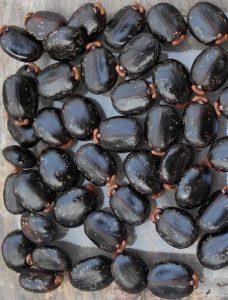 |
English Name: Castor
Species: Ricinus communis L. Name of variety: NCRICAS1 Origin / Source: NCRI – Badeggi Type of variety: Open pollinated Morphological Characteristics: Pink waxy stem; medium spike length; green leaves; compact capsule, green capsules and large black seeds. Days to Maturityof 1o Raceme: 102 – 109 days Adaptation: Rainforest and Guinea Savanna Ecologies Potential Yield: 1.7 t/ha Seed Oil Content: 38.94% Outstanding Characteristics: High seed yield and large endosperm/seeded Nutrients: %Protein: 24.52, %Fats: 38.94, %CHO: 30.54, %Ash: 3.45, %Fibre: 2.83 Year of release: 2019 |
|
2 |
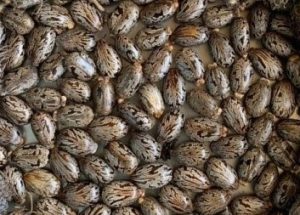 |
English Name: Castor
Species: Ricinus communis L. Name of variety: NCRICAS2 Origin / Source: NCRI – Badeggi Type of variety: Open pollinated Morphological Characteristics: Long spike; pink waxy stem; green leaves; green capsules and brown seeds Days to Maturityof 1o Raceme: 69 – 74 days Adaptation: Rainforest and Savanna Ecologies Potential Yield: 1.9 t/ha Seed Oil Content: 54.05% Outstanding Characteristics: High yield; high oil content; early maturity and good oil physicochemical properties Nutrients: %Protein: 14.73, %Fats: 54.05, %CHO: 14.63, %Ash: 5.81, %Fibre: 1.56% Year of release: 2019 |
|
3 |
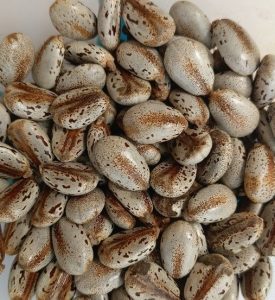 |
English Name: Castor
Species: Ricinus communis L. Name of variety: NCRICAS3 Origin / Source: NCRI – Badeggi Type of variety: Open pollinated Morphological Characteristics: Large white elongated seeds, mahogany stem colour; green leaves and green capsules Days to Maturityof 1o Raceme: 115 – 121 Adaptation: Rainforest and Savanna Ecologies Potential Yield: 2.1 t/ha Seed Oil Content: 37.41% Outstanding Characteristics: High seed yield and large endosperm Nutrients: % Protein: 28.59, % Fat: 37.41, % CHO: 30.54, % Ash: 4.44, % Fibre: 1.50 Year of release: 2024 |
|
4 |
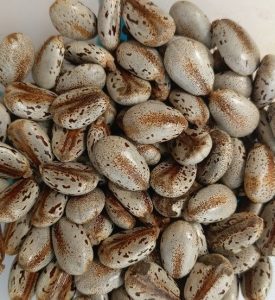 |
English Name: Castor
Species: Ricinus communis L. Name of variety: NCRICAS4 Origin / Source: NCRI – Badeggi Type of variety: Open pollinated Morphological Characteristics: Large white squared seeds, green stem colour; green leaves and green capsules Days to Maturityof 1o Raceme: 118 – 130 Adaptation: Rainforest and Savanna Ecologies Potential Yield: 2.8 t/ha Seed Oil Content: 42.41% Outstanding Characteristics: High seed yield and large endosperm Nutrients: % Protein: 27.59, % Fat: 42.41, % CHO: 26.54, % Ash: 4.44, % Fibre: 1.50 Year of release: 2024 |
Other Technologies Developed by Castor Research Program
- Determination of Appropriate Time of Planting Castor: For optimum yield, plant castor in early to mid-June in the Guinea savanna, in mid- June to early July in the Sahel and Sudan savanna respectively. In the southern states where castor is mostly grown as a perennial, plant castor in the months of April/May for optimum yield.
- Determination of Appropriate Plant Spacing for Optimum Yield of Castor: Plant spacing of 0.75 – 1.0m between the row or ridge and 0.5 – 0.75 within the row or ridge have been found adequate for use in the northern part of Nigeria, while a plant spacing of 1.5 x 1.0m between and within the row respectively are recommended for use in the southern part of Nigeria.
- Development of Appropriate Insecticides/Fungicides Spraying Regimes for Adequate Pest/Disease Control in Castor Production: Experiment carried out at the Castor Research Proogramme of the National Cereals Research Institute(NCRI) indicated that three spray regimes of insecticide (i.e.100mls of Magic force(i.a.Lambda-cyhalothrin 15g/l + Dimethoate 300g/l) and 40g of fungicide (a.i Mancozebe + Acetamipride) added to 16l of water in a knapsack, applied 1st at one week after seedling emergence, the 2nd and 3rd at one and two weeks after flower bud initiation resulted in adequate pest and disease control and optimum yield of castor.
- Castor cropping system: Development of technologies for intercropping castor with soybean and intercropping castor with maize for optimum yields of the component crops.
- Fertilizer Application: Generally, fertilizer should be band-applied at the rate of 30kg/ha N P K respectively at 4 weeks after planting in the northern states. Preferably, the phosphorus source should be single-super phosphate (SSP). In addition to phosphorus, SSP contains calcium and sulphur. Calcium neutralizes soil acidity, while sulphur enhances oil yield in oil seed crops like castor. The band-application should be followed by side dressing with urea at flower bud initiation at the rate of 20kg N/ha. In the southern states, basal application of N P K at the rate of 30kg/ha respectively have also been found adequate for optimum castor yield. However, there may not be need to side dress with urea because soils in the southern states are generally higher in N than soils in the northern states.
- Determination of Oil Yield of Small Seeded and Large Seeded Castor: Small Seeded Castor Produced High Oil Yield than Large Seeded at the Same Quantity.
- Collaborated with the engineering department of the institute to develop a castor shelling machine.
- Collection of more Local Germplasm: More Genetic Variability has been created through germplasm collection
- Development of a Morphological Descriptor for Proper Characterization of the Germplasm
- Morphological Characterization of Some Castor Accessions
- Development of improved castor genotypes for release
| Objectives |
|
| Research Strategies |
|
| Output |
|
| Outcomes
|
|
| Performance Indicators
|
|